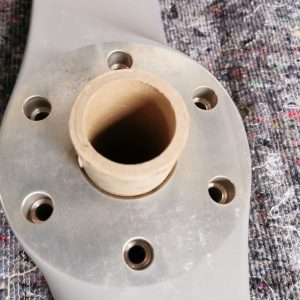
New, Never Installed offers replacement and project value for buyers seeking an unused fixed-pitch propeller with clear manufacturer identification and documented storage history.
The shortened Sensenich 74DM6 Propeller description can improve search visibility, while the complete part number should remain available for technical review.
These related phrases connect the product with buyers seeking a durable and comparatively straightforward general aviation propeller design.
A Lycoming O-320 Propeller may only be appropriate for selected engine and airframe combinations, even when the basic engine family appears compatible.
A Two-Blade Aircraft Propeller should be treated as one matched rotating assembly, while a Sensenich Aircraft Propeller should be identified through verified manufacturer markings.
Confirming the Exact Aircraft Propeller
A propeller should not be accepted as P/N 74DM6-0-60 solely because it resembles another Sensenich model shown in a catalog or online advertisement.
Any approved change should appear in suitable records and markings rather than relying only on verbal descriptions.
New and Never Installed Condition
Transparent history helps buyers understand the difference between unused status and current installation readiness.
Detailed condition evidence supports responsible marketing of the Sensenich Propeller – P/N 74DM6-0-60
Sensenich Fixed-Pitch Propeller Design
Its practical performance depends on blade design, diameter, pitch, engine power, maximum RPM, airframe configuration, aircraft weight, altitude, temperature, and installation condition.
Professional verification supports responsible use of the Sensenich Fixed-Pitch Propeller.
Protecting Aluminum Propeller Surfaces
Material condition should be reviewed by appropriately qualified aviation personnel.
Both blade faces, backs, roots, tips, leading edges, trailing edges, and hub transitions should be examined under suitable lighting.
Avoiding Unverified Propeller Size Claims
Verified dimensions support correct replacement-propeller selection.
Blade-tip shape, symmetry, and previous alteration can influence measurement accuracy.
Understanding the 60-Inch Pitch Propeller
Pitch influences theoretical forward movement, engine loading, achievable RPM, climb behavior, and cruise characteristics.
Any pitch modification should be completed by an appropriately qualified facility and documented accurately.
Lycoming O-320 Propeller Compatibility
The Lycoming O-320 engine family includes different models, power ratings, flange configurations, operating limits, and aircraft applications.
Qualified research supports responsible selection of a Lycoming O-320 Propeller.
Two-Blade Aircraft Propeller Configuration
Matched blade condition supports smoother propeller operation.
Storage supports should protect both blades without applying uneven pressure.
Preparing the Replacement Aircraft Propeller
Mounting holes should remain free from corrosion, damaged edges, contamination, improper machining, impact marks, and unexplained installation impressions.
Professional hardware selection protects the engine and Replacement Aircraft Propeller.
Evaluating Scratches, Dents, and Finish Damage
Professional evaluation protects the Sensenich Aircraft Propeller from unsuitable installation.
Suspicious areas should be examined carefully after the wrapping is removed using appropriate handling procedures.
Maintaining the Factory Finish
Aluminum propellers can develop corrosion after exposure to moisture, condensation, coastal air, chemicals, damaged coatings, or unsuitable storage materials.
Responsible storage protects the Fixed-Pitch Aluminum Propeller.
Supporting Installation Eligibility
Certified design status does not automatically establish the present serviceability, airworthiness, or installation eligibility of an individual propeller.
All documents should remain permanently associated with the correct physical propeller.
Maintaining Aircraft Propeller History
Original purchase paperwork may help establish the never-installed history.
Complete history supports future maintenance, installation research, and resale.
Replacement Propeller Buying Guide
A pre-purchase review should confirm the complete model, serial number, diameter, pitch, blade count, hub configuration, mounting pattern, manufacturing information, storage history, physical condition, applicability, and documentation.
- Confirm P/N 74DM6-0-60, the complete serial number, manufacturer markings, 74-inch diameter, 60-inch pitch, blade count, hub dimensions, bolt pattern, and original configuration.
- Do not treat original packaging, clean paint, new wording, or never-installed status as proof of present serviceability.
- Require packaging that protects the blades, tips, edges, hub, data plate, mounting face, bolt holes, factory finish, records, and included hardware from impact, abrasion, moisture, and movement.
Protecting a New Two-Blade Propeller in Transit
Blade tips, leading edges, trailing edges, mounting surfaces, bolt holes, identification plates, and factory coatings require suitable protection.
Pre-shipment photographs can document the blades, hub, packaging, identification, and included parts before collection.
Maintaining Packaging and Identification
Storage click here supports should avoid concentrating weight on blade tips, edges, or thin blade surfaces.
Periodic inspection can identify developing corrosion, packaging damage, coating defects, or mishandling.
Completing the Propeller and Spinner Assembly
Incorrect bolts, unsuitable washers, damaged threads, or improvised spacers should not be used.
Disciplined installation supports dependable Two-Blade Aircraft Propeller operation.
A ground run should not replace incomplete compatibility research or required technical inspection.
Maintaining the Leading Edges and Finish
Unapproved filing or sanding can remove excessive material and alter the blade geometry.
Preventive care supports dependable General Aviation Propeller service.
Choosing a Valuable Aviation Component
Original packaging can improve presentation and provenance but does not replace physical examination.
Commercial evaluation should focus on verified suitability rather than condition wording alone.
74DM6-0-60 Aircraft Propeller Conclusion
When thoroughly evaluated, documented, packaged, installed, and maintained, the Sensenich Propeller – P/N 74DM6-0-60
The propeller should be evaluated with the receiving aircraft’s Lycoming engine, flange, spinner, operating limitations, clearances, and approved installation requirements in mind.
Whether the product is described as a 74-Inch Aircraft Propeller, 60-Inch Pitch Propeller, Lycoming O-320 Propeller, or General Aviation Propeller, aircraft-specific applicability remains essential.
New, Never Installed can deliver a professional combination of fixed-pitch simplicity, aluminum construction, replacement value, and general aviation application potential.